
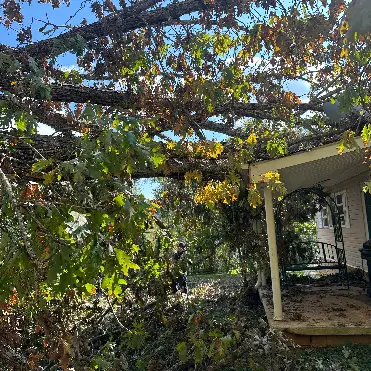
Storm damage is a regular part of life in Haywood County. Between heavy rains, saturated soil, and strong winds moving through mountain gaps, trees often fall or weaken during storms. In areas like Waynesville, Clyde, and Maggie Valley, even healthy trees can become a risk under the right conditions.
Knowing how to respond after a storm can help protect your home and prevent further damage.
Why Storm Damage Is Common in Haywood County
The landscape in Haywood County creates unique challenges. Homes are often built on slopes, and many properties sit below wooded hillsides. When storms move through, wind can funnel through valleys, increasing force in certain areas.
Several local factors increase the risk:
- Clay-heavy soil that softens quickly after rain
- Steep terrain that allows trees to fall with more force
- Older trees weakened by pests or decay
- Dense tree coverage close to homes and roads
These conditions mean storm damage can happen quickly, even when winds are not extreme.
The Most Dangerous Post-Storm Tree Hazards
After a storm, some of the most serious risks are not always obvious.
Watch for:
- Trees leaning toward structures
- Large limbs hanging or partially broken
- Split trunks or cracks along the base
- Uprooted trees that have not fully fallen
- Trees resting on roofs, fences, or power lines
These situations can change quickly. A tree that looks stable may shift without warning.
Why Immediate Removal Matters
Waiting too long to address storm damage can make the situation worse. A damaged tree can continue to move, especially as the ground dries or shifts. Water damage, roof collapse, and blocked access are all common results when removal is delayed.
Quick action helps:
- Prevent further structural damage
- Keep driveways and roads accessible
- Reduce safety risks for family and neighbors
Challenges of Tree Removal in Mountain Areas

Tree removal in Haywood County is not the same as in flat regions. Sloped land and limited access make the work more complex.
Crews often deal with:
- Tight spaces near homes and driveways
- Narrow roads that limit equipment size
- Trees that must be lowered in sections rather than cut all at once
- Ground that shifts under heavy machinery
Experience with local terrain makes a real difference in both safety and results.
When to Call a Tree Service in Haywood County
You should contact a professional if:
- A tree has fallen on your home or property
- Large limbs are hanging overhead
- A tree is leaning after a storm
- You cannot safely assess the damage
If you are unsure, it is better to have the situation evaluated than to wait.
If you need storm damage tree removal in Haywood County, call Haynes Tree & Excavation at (828) 775-7645. We provide 24/7 response throughout Waynesville, Clyde, Maggie Valley, and surrounding communities.
Reducing Future Storm Risk
While storms cannot be controlled, the impact can be reduced. Regular inspections, removal of weak trees, and trimming overgrown limbs help lower the chance of damage.
In Haywood County, where terrain and weather work together, preparation is one of the most effective ways to protect your property.
If you are dealing with storm damage or a fallen tree, it is best to act quickly. Waiting can lead to further damage and higher repair costs. For prompt, professional help in Haywood County, call Haynes Tree & Excavation at (828) 775-7645. We provide 24/7 emergency service throughout Waynesville, Clyde, Maggie Valley, and nearby areas.